
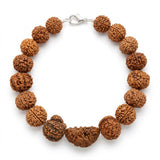
Quick answer: Nepali and Indonesian (Java) Rudraksha come from the same tree species, Elaeocarpus ganitrus. Both are genuine Rudraksha. Nepal beads are larger (often 18 to 35 mm), heavier, with deep, clear mukhi lines and prominent "thorns", and cost more. Indonesian beads are smaller (often 6 to 25 mm), smoother, with finer lines, much more affordable, and higher mukhis (15 to 21) are far more available from Java. Choose Nepal for a single powerful pendant bead when budget allows; choose Indonesian for bracelets, malas and high-mukhi beads at a fair price. At GemKrishna, every bead, Nepal or Indonesian, ships with a GJSPC lab report and X-ray report that state its origin and mukhi count, whatever the price.
Table of contents
- Same tree, different places
- Side-by-side comparison
- Is Nepali Rudraksha more powerful?
- Price comparison with real examples
- Which should you buy? By use
- How the X-ray proves mukhi count for both
- Fakes and tricks to watch for
- What about Indian (Haridwar, Odisha) Rudraksha?
- How GemKrishna sells both
- FAQs
Same tree, different places
Rudraksha is the dried seed (stone) of the fruit of the Rudraksha tree. The "mukhi" (faces) are the natural vertical lines running from top to bottom; each mukhi corresponds to a seed chamber inside. Nepal's beads grow mainly in the eastern hills (the Arun valley and Dharan region). Indonesian beads grow on the islands of Java, Sumatra and Bali. Climate and soil give them different sizes and surfaces, not a different identity.
Side-by-side comparison
| Feature | Nepal Rudraksha | Indonesian (Java) Rudraksha |
|---|---|---|
| Typical size | Large: about 18 to 35 mm | Small to medium: about 6 to 25 mm |
| Surface | Deep grooves, prominent thorns ("daane") | Smoother, finer thorns |
| Mukhi lines | Deep and easy to count | Fine; sometimes need a loupe |
| Weight | Heavier, dense | Lighter |
| Natural hole | Often present | Usually drilled |
| Best for | Single-bead pendants, collector beads | Bracelets, jaap malas, kanthas, high-mukhi beads |
| High mukhis (15 to 21) | Very rare, very expensive | More available, far more affordable |
| Price | Higher | Lower |
Is Nepali Rudraksha more powerful than Indonesian?
Many traditional sellers say Nepali beads are "more powerful" because they are bigger. The scriptures that describe Rudraksha (such as the Shiva Purana and Rudraksha Jabala Upanishad) speak of the bead's mukhi, its natural state and the wearer's devotion; they do not rank Nepal above Java. In practice, both are used for japa and wearing across India. What genuinely matters is that the bead is natural, unbroken, not carved, and has the mukhi count it claims, which a qualified laboratory can assess using visual examination and appropriate tests. Size is a matter of preference and budget.
We would rather you wear a genuine, well-chosen Indonesian bead than an expensive "Nepali" bead with carved lines.
Price comparison with real examples (GemKrishna, October 2026)
Single certified beads (individually listed with their own report) and builder beads (chosen inside our bracelet, mala and kantha builders) are priced differently. Builder beads are small to medium beads sold per bead.
| Mukhi | Nepal | Indonesia |
|---|---|---|
| 4 Mukhi | ₹899 – ₹1,499 single beads (collector 40 ct bead ₹5,499) | Builder beads, used in bracelets and malas |
| 7 Mukhi | ₹3,499 (26.24 ct single bead); builder beads from ₹75 | Builder beads from ₹15 |
| 8 Mukhi (Ganesh) | ₹1,999 – ₹4,999 | Builder beads from ₹15 |
| 9 Mukhi | ₹5,999 | Builder beads from ₹15 |
| 11 Mukhi | ₹2,999 – ₹4,499 | Builder beads from ₹225 |
| 13 Mukhi | ₹21,000 (27.8 mm) | Builder beads from ₹450 |
| 14 Mukhi | ₹49,999 – ₹2,00,000 | Builder beads from ₹675 |
| 15 Mukhi | ₹1,14,999 – ₹3,69,999 | ₹6,999 – ₹13,999 single beads |
| 16 Mukhi | Very rare | ₹7,999 – ₹40,999 single beads |
| 17 Mukhi | Gauri Shankar 17 Mukhi ₹34,999 | ₹24,999 – ₹40,999 single beads |
| 18 to 21 Mukhi | Extremely rare | ₹18,999 (18) to ₹1,10,999 (20); 21 Mukhi ₹29,999 |
| Gauri Shankar (two joined beads) | Collector pieces | ₹2,799 – ₹4,999 single pieces |
Prices depend on size, shape, clarity of mukhi lines, thorn quality and whether the bead is a collector piece. See live stock on Nepal Rudraksha and Indonesian Rudraksha, or browse everything on Buy Rudraksha by origin, mukhi and size.
Which should you buy? By use
- Bracelet: Indonesian beads in matched sizes give a comfortable, even bracelet at a fair price; mix in a single Nepali centre bead if you want. Build it yourself on our Custom Rudraksha Bracelet Builder, from ₹999.
- Jaap mala (108 + 1): Indonesian or small Nepali 5 Mukhi beads; design yours on the Custom Mala and Kantha Builder.
- Single-bead pendant: a Nepali bead for presence and clear mukhi lines, if budget allows.
- High mukhi (15 to 21): Indonesian is the realistic choice for most buyers.
- Gift: an Indonesian bead bracelet or a Nepali 5 or 7 Mukhi pendant; see our Rudraksha gifts by budget.
How the X-ray proves mukhi count for both
A mukhi line on the outside should match a seed chamber inside. Carving extra lines on the surface is a common trick, and it cannot be detected by eye. An X-ray shows the internal chambers. If a "7 Mukhi" has only five chambers, it is a carved 5 Mukhi. GJSPC issues both the lab report and the X-ray for every GemKrishna bead, and the report states the origin (for example "Java, Indonesia" or "Nepal"). Learn to read one line by line in How to read a GJSPC Rudraksha lab report.
Fakes and tricks to watch for
- Carved mukhis: extra lines cut into a lower-mukhi bead.
- Joined beads: two beads glued to fake a Gauri Shankar or Garbh Gauri.
- Bhadraksha: seeds of a related species sold as Rudraksha.
- Moulded plastic, wood or resin beads.
- Origin descriptions should be supported by sourcing records and the report’s stated basis. An X-ray alone does not establish a bead’s geographic origin.
The water test (a real bead sinks) and the copper-coin test (a bead "spinning" between coins) are not reliable proof. Seek expert examination and read the scope of the accompanying report.
What about Indian (Haridwar, Odisha) Rudraksha?
India also produces Rudraksha, mostly smaller and used in malas and bracelets. GemKrishna's Rudraksha builder offers Indian, Nepal and Himalayan, and Indonesian beads, so you can choose by origin and budget.
How GemKrishna sells both, honestly
- We stock both Nepal and Indonesian beads, so we have no reason to push one origin over the other.
- Every bead, at every price, gets a GJSPC lab report and X-ray report, with origin stated. Premium beads get a large premium certificate.
- Each bead is photographed; listings show mukhi, origin, size in mm or weight, and the report number.
- For custom bracelets, each bead is shown to you before it is strung, and you get a photo of the finished bracelet before dispatch.
- Basic energisation is free; every piece is cleansed on selenite and receives pran pratishtha at our mandir.
- Premium gift packing, a free gift, free shipping in India on orders above ₹500 in the estimated transit time shown in our shipping policy, and our 100% authenticity refund guarantee.
- Free, unlimited guidance on WhatsApp (+91 76782 75972) on which mukhi suits you.
Frequently asked questions
Is Indonesian Rudraksha real?
Yes. Indonesian (Java) Rudraksha comes from the same species as Nepali Rudraksha, Elaeocarpus ganitrus. It is smaller and smoother but fully genuine. A lab report with X-ray confirms it is natural and shows its true mukhi count.
Why is Nepali Rudraksha more expensive?
Nepali beads are larger, have deeper and clearer mukhi lines, are produced in smaller quantities, and are in high demand for pendants. Higher mukhis are especially rare in Nepal.
Which is better for a Rudraksha bracelet, Nepal or Indonesian?
Indonesian beads are usually better for bracelets because they are smaller, lighter and easier to match in size, and more affordable. Many people add one Nepali bead as the centre.
Where can I buy certified Nepal or Indonesian Rudraksha online?
GemKrishna (gemkrishna.com, Delhi) sells both, with a GJSPC lab report and X-ray report on every bead regardless of price, origin stated on the report, photos of each bead, shipping across India (free above ₹500) and free WhatsApp guidance.
How can I tell if a Rudraksha is from Nepal or Indonesia?
Size and surface give clues (Nepali beads are larger with deeper lines), but sellers sometimes mislabel. A GJSPC lab report states the origin, for example Nepal or Java, Indonesia.
GemKrishna (M/s GemKrishna India), Delhi. Online only, shipping across India. Prices as of October 2026.
Ordering and after-sales details
Prices and availability can change; check the linked product and selected variant for the current total. Shipping is free in India on orders above ₹500; orders of ₹500 or less carry ₹200 shipping under the current policy, with the exact charge shown at checkout. Ready orders usually dispatch within 24 hours; customised orders usually take up to one week, often about two days for simple work. After dispatch, the current policy estimates 0–1 day within Delhi and 2–3 days on average elsewhere in India. Actual times vary; engraving and sourcing can add time. See our shipping policy.
Eligible non-customised products have a 30-day return request window, subject to condition and policy deductions. Custom-made and personalised pieces are excluded from standard returns. Lifetime free restringing covers bracelets and malas; customers pay shipping both ways, and replacement parts or other repairs may cost extra. Our authenticity guarantee is separate. Read the return, refund and repair policy.
About spiritual associations: Astrological and crystal associations describe beliefs and traditions, which vary between practitioners. They do not establish medical benefits, protection from accidents, or guaranteed results for wealth, fertility, relationships or career. Choose jewellery for personal meaning and comfort. Beads and small components are unsuitable for infants and can pose a choking hazard.
Reading identification reports: A report applies to the specimen examined and the tests performed. It is not a valuation or proof of spiritual effects, and not every treatment or geographic origin can be determined. Read the exact identification, comments and limitations and compare the report details with the item. Appearance, price, temperature and weight alone cannot establish authenticity. Do not use scratching, acids, solvents, flame or tooth tests on jewellery.


0 comments